Health geography
Applying geographical perspectives to health, disease, and healthcare.
Health geography uses geographic ideas, tools, and viewpoints to examine health, illness, and healthcare systems. A related or overlapping field, medical geography, looks at where health and disease occur and how these patterns connect to both natural and social surroundings. Traditionally, medical geography has two main research branches: one studies where and why sickness and death happen, and the other focuses on healthcare planning, how people seek help, and how medical services are delivered.
The first branch is sometimes called geographical epidemiology or disease geography. It examines the spatial patterns and processes behind health outcomes. What sets it apart from standard epidemiology is its use of geographic concepts and methods, which provide an ecological perspective that considers how human-environment interactions lead to specific health results. The second branch deals with planning and providing healthcare, often exploring how health systems are arranged in space and how that arrangement affects people’s access to care.
Health geography has evolved as medical geography was rethought within social geography, driven by a move from a purely medical model to a social model of health. This shift redefines health and healthcare beyond just preventing and treating illness, aiming instead to promote overall well-being. Under this social model, some conditions once seen as illnesses—like mental health issues—are viewed as behavioral disturbances, and other forms of medicine (such as complementary, alternative, or traditional practices) are studied by researchers, sometimes with help from health geographers who lack medical training. This changes the definition of care, expanding it beyond hospitals and doctors’ offices. It also prioritizes intimate encounters in non-traditional healthcare spaces and treats individuals as health consumers. This alternative approach broadens medical geography to include philosophies like Marxian political economy, structuralism, social interactionism, humanism, feminism, and queer theory.
The link between place and health has been understood for millennia, long before modern healthcare systems existed. It offered insights into disease transmission even before the germ theory emerged in the late 1800s. Throughout history, location has shaped perceptions of health and risk. Hippocrates recognized these connections ov
- field
- Health geography
- sub-discipline
- Medical geography
- primary research areas
- Spatial distribution of morbidity and mortality; health planning and provision of health services
- key historical figure
- John Snow
- modern pioneers
- Jacques May, John B. Calhoun, and others across multiple countries
- foundational text
- On Airs, Waters, and Places by Hippocrates (c. 400 BC)
Lore & Background
Health geography applies geographical information, perspectives, and methods to the study of health, disease, and health care. Medical geography, a sub-discipline or sister field, focuses on understanding spatial patterns of health and disease in relation to the natural and social environment. Conventionally, there are two primary areas of research: the spatial distribution and determinants of morbidity and mortality, and health planning, help-seeking behavior, and the provision of health services.
Reader's Guide
Health geography has been influenced by repositioning medical geography within social geography due to a shift toward a social model in health care, rather than a medical model. This advocates for redefining health and health care away from only prevention and treatment of illness to promoting well-being in general. Under this model, some previous illnesses are recognized as behavior disturbances, and other types of medicine are studied with the aid of health geographers. This shift changes the definition of care, no longer limiting it to spaces such as hospitals or doctor's offices. The social model gives priority to intimate encounters at non-traditional spaces of medicine and healthcare and to individuals as health consumers. This alternative methodological approach broadens medical geography to incorporate philosophies such as Marxian political economy, structuralism, social interactionism, humanism, feminism, and queer theory.
Did You Know?
- Hippocrates recognized associations between geographical characteristics and health outcomes more than 2,000 years ago in his treatise On Airs, Waters, and Places.
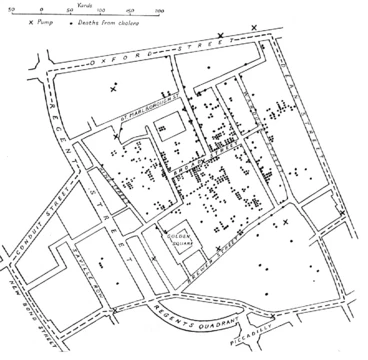
- John Snow's 1854 map of the Broad Street cholera outbreak demonstrated cases clustered around a contaminated water pump, leading to the conclusion that cholera was waterborne.
- Modern medical geography arose in the United States in the 1950s with the pioneering work of Jacques May, who noticed differences in health experiences between patients in Thailand, Vietnam, and Europe.
- Geographic Information Systems (GIS) are used extensively in medical geography to visualize and analyze georeferenced health-related data.
More in Spatial Analysis & Gis 1-24
Spotted an error? Know more?
This is a living reference — every entry is fact-audited, and reader corrections feed straight into our audit queue. Suggest an edit · See this site's audit record