Human geography
Study of spatial relationships between human communities and their environments.
Human geography, sometimes called anthropogeography, examines how people interact with the places they inhabit. It looks at the spatial patterns formed by human communities, cultures, economies, lifestyles, and their environments—studying things like urban sprawl and redevelopment. Researchers use both descriptive (qualitative) and numerical (quantitative) methods to understand how social connections relate to the environment. The field pulls from sociology, anthropology, economics, and environmental science to build a fuller picture of how human activity shapes the spaces we live in.
The Royal Geographical Society was founded in England in 1830. The UK’s first geography professor was appointed in 1883, and Halford John Mackinder, named professor of geography at the University of Oxford in 1887, became the country’s first major geographic thinker. In the United States, the National Geographic Society was founded in 1888 and started publishing *National Geographic* magazine, which became a major force in popularizing geographic knowledge and has long supported research and education. The Association of American Geographers, founded in 1904, was renamed the American Association of Geographers in 2016 to reflect its growing international membership.
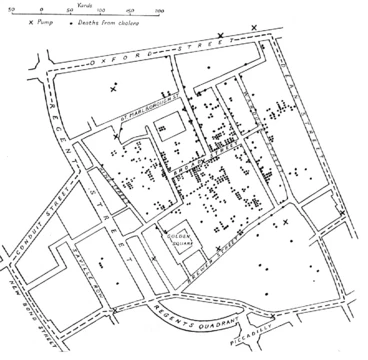
One early use of geographic methods beyond describing Earth’s physical features was John Snow’s map of the 1854 Broad Street cholera outbreak. Though Snow was a physician and epidemiology pioneer, not a geographer, his map is an early example of health geography. The clear split between physical and human geography came later. The link between physical and human geography is clearest in environmental determinism, popularized in the 19th century by Carl Ritter and others, which held that people’s physical, mental, and moral traits were directly shaped by their natural environment. This theory was tied to the evolutionary biology of the time. By the mid-19th century, however, it faced criticism for lacking the rigor of modern science and was later used to justify racism and imperialism.
During the late 19th and first half of the 20th centuries, regional geography focused on both human and physical aspects. Its goal was to divide space into regions and describe each region’s unique human and physical features. Tied to possibilism and cultural ecology, some ideas about the environment’s causal influence on society
- field
- Human geography (anthropogeography)
- known_for
- Studying spatial relationships between human communities and environments; subfields include cultural, economic, political, and health geography
- methods
- Qualitative (descriptive) and quantitative (numerical) methods
- related_disciplines
- Sociology, anthropology, economics, environmental science
- key_historical_figure
- Halford John Mackinder (appointed professor of geography at the University of Oxford in 1887)
Lore & Background
The Royal Geographical Society was founded in England in 1830. The first professor of geography in the United Kingdom was appointed in 1883, and Halford John Mackinder became a major geographical intellect, appointed professor at the University of Oxford in 1887. The National Geographic Society was founded in the United States in 1888 and began publishing National Geographic magazine, popularizing geographic information. The Association of American Geographers was founded in 1904 and renamed the American Association of Geographers in 2016.
One early e
Reader's Guide
Human geography's significance lies in its comprehensive framework for understanding how human activity shapes and is shaped by spatial environments. It emerged from a tradition that initially blended physical and human aspects, as seen in environmental determinism and regional geography, but later developed distinct subfields. The quantitative revolution of the 1960s introduced rigorous statistical methods, while critical geography from the 1970s challenged positivist detachment, incorporating Marxist and humanistic perspectives. This evolution has produced diverse subfields—cultural, economic, political, health, population, and urban geography—each addressing specific spatial patterns and social processes. Human geography remains vital for analyzing contemporary issues such as urban sprawl, disease spread, and political spatial dynamics, drawing on multiple disciplines to provide holistic insights. Its legacy includes the use of geographic information systems and ongoing debates about methodology and engagement with social justice.
Did You Know?
- John Snow's 1854 map of the Broad Street cholera outbreak is considered one of the earliest examples of health geography.
- Environmental determinism, popularized in the 19th century by Carl Ritter, was later criticized for lacking scientific rigor and for justifying racism and imperialism.
- The quantitative revolution of the 1960s led to the application of statistical and mathematical models in geography, influencing geographic information systems.
- Radical geography, emerging in the 1970s and 1980s, draws heavily on Marxist theory and is associated with geographers David Harvey and Richard Peet.
More in Spatial Analysis & Gis 1-24
Spotted an error? Know more?
This is a living reference — every entry is fact-audited, and reader corrections feed straight into our audit queue. Suggest an edit · See this site's audit record